Does faster drafting solve the real delay?
If analysts spend most of their time finding sources, a faster writer leaves the main burden untouched. Check where effort and waiting time actually go.
A publication for life sciences leaders
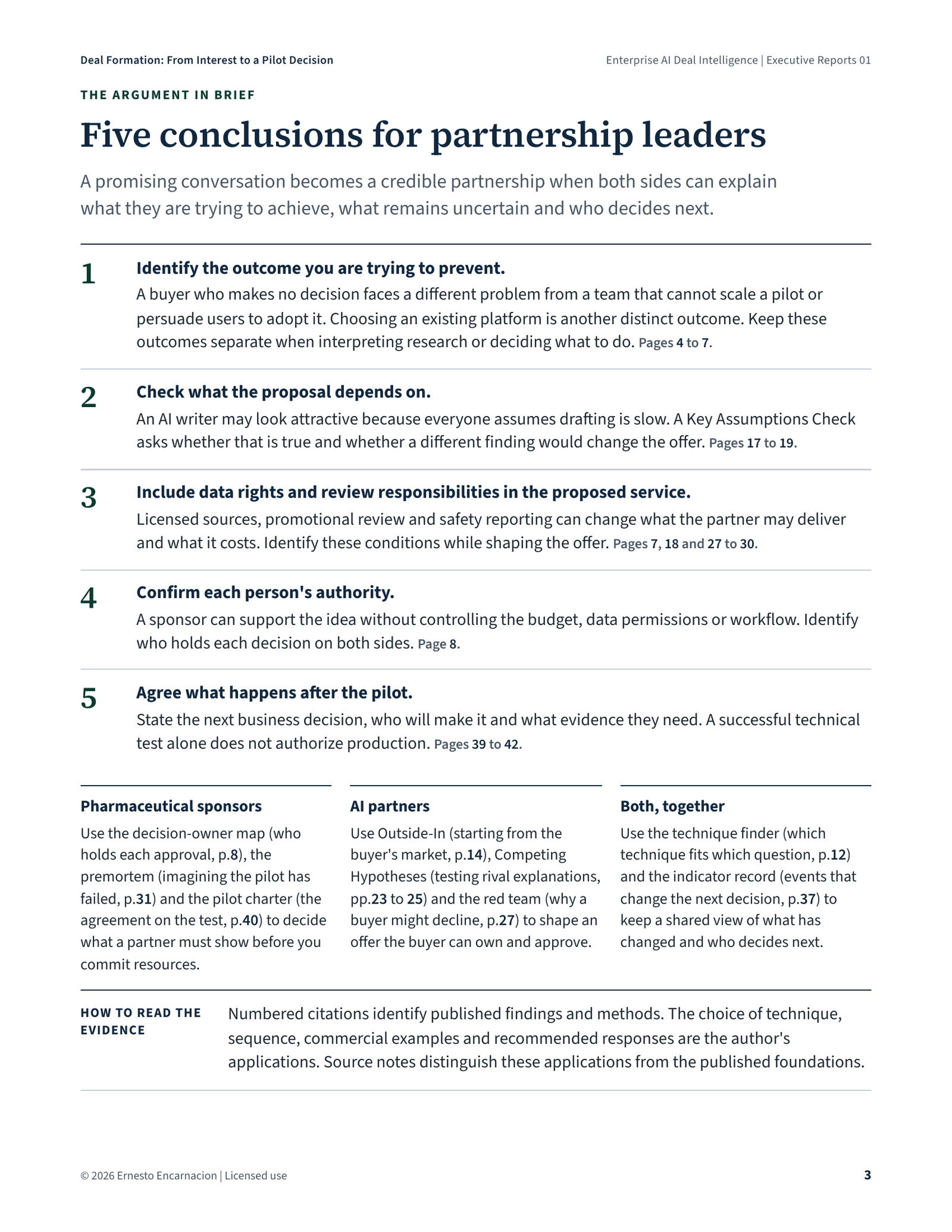
Before committing budget, people and data to an AI partnership, leaders need to agree on the business problem, who will own the work and what evidence would change the plan. Enterprise AI Deal Intelligence applies structured analytic techniques, the methods analysts use to test their own reasoning, to those decisions.
Explore the decision map The preview downloads directly. No sign-up.
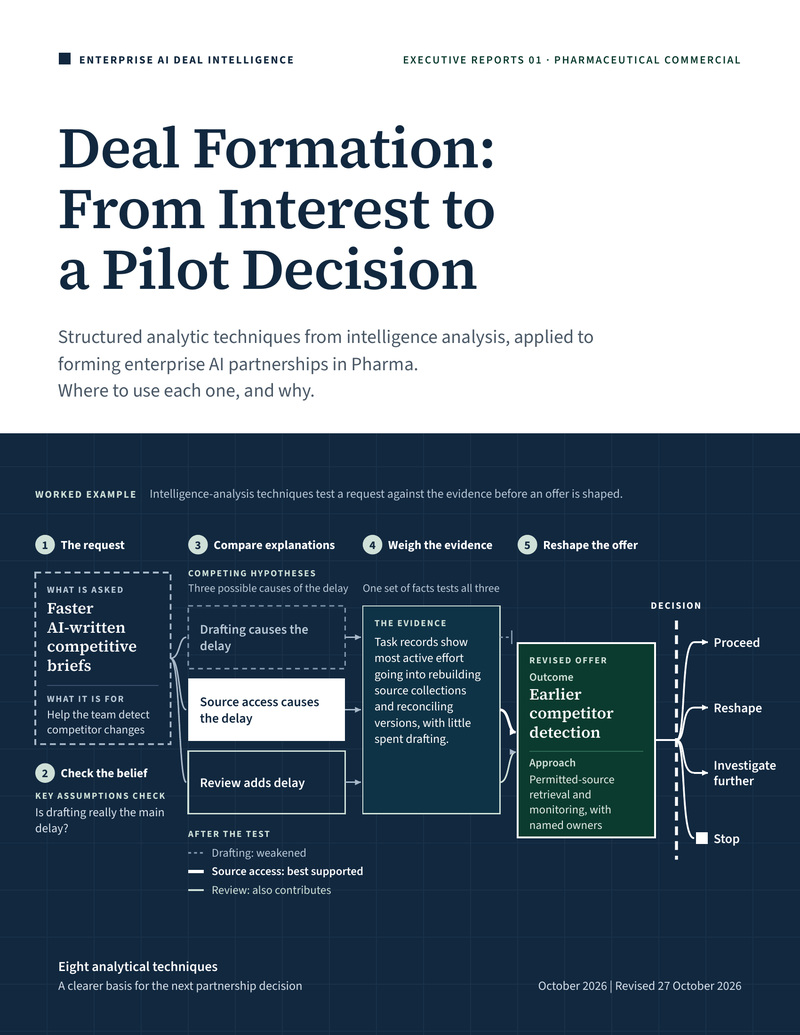
Worked example
A brand planning team asks for faster AI-written competitive briefs. Two structured analytic techniques turn that request into a different, better-founded proposal.
1 Request
Faster AI-written competitive briefs
Key Assumptions Check Is drafting really the main delay? If not, an AI writer misses the burden.
2 Competing explanations of the burden
Competing Hypotheses Compare all three against the same evidence before choosing a solution.
3 Evidence
Task records show most active effort going into rebuilding permitted source collections and reconciling versions, with little spent drafting. Review needs an acceptance standard and an owner.
4 Revised offer
A maintained collection of permitted sources, with retrieval and change alerts
Defer synthesis until its additional value is clear.
5 Decision
Authorize a bounded evaluation only when its question, sources, criteria, responsibilities and funding are agreed.
The offer changed because the evidence pointed away from drafting. Had it shown composition as the main burden, the right test would have compared AI-assisted composition with the current method and a simpler template, counting checking and correction in every option.
The request
A brand planning team wants an AI writer to produce competitive briefs faster. Its sponsor supports the idea, some required sources carry third-party licenses, and no manager has accepted responsibility for the workflow after the pilot.
The real need
Asking why the briefs matter now moves the discussion from writing briefs faster to detecting competitor changes sooner. That changes what the team should measure.
Three explanations, tested against the same evidence
The changed offer
Reframe the initial service as a maintained collection of permitted sources, with retrieval and change alerts. Defer synthesis until its additional value is clear. One licensed source needed third-party access approval, so licensed data is added only after approval.
What the pilot measures
The time from a relevant source becoming available to a verified update reaching the person who acts on it. Before testing, the parties agree the sources, observation period and success threshold.
The approach
Many AI partnerships stall in the same places. Interest never becomes a decision. A pilot passes its technical tests, yet nobody owns what happens next. A tool arrives, and people keep working the old way. These are different problems with different causes, and each needs a different response.
Structured analytic techniques are methods intelligence analysts developed to examine their own reasoning: list the assumptions, check how much weight the evidence can bear, compare rival explanations and ask what would change the conclusion. In partnership work, they help a buyer and a provider test the reasoning together while the offer can still change. The short name is SATs.
If analysts spend most of their time finding sources, a faster writer leaves the main burden untouched. Check where effort and waiting time actually go.
A sponsor can support the idea without controlling the budget, data permissions or the workflow. Name each decision owner on both sides.
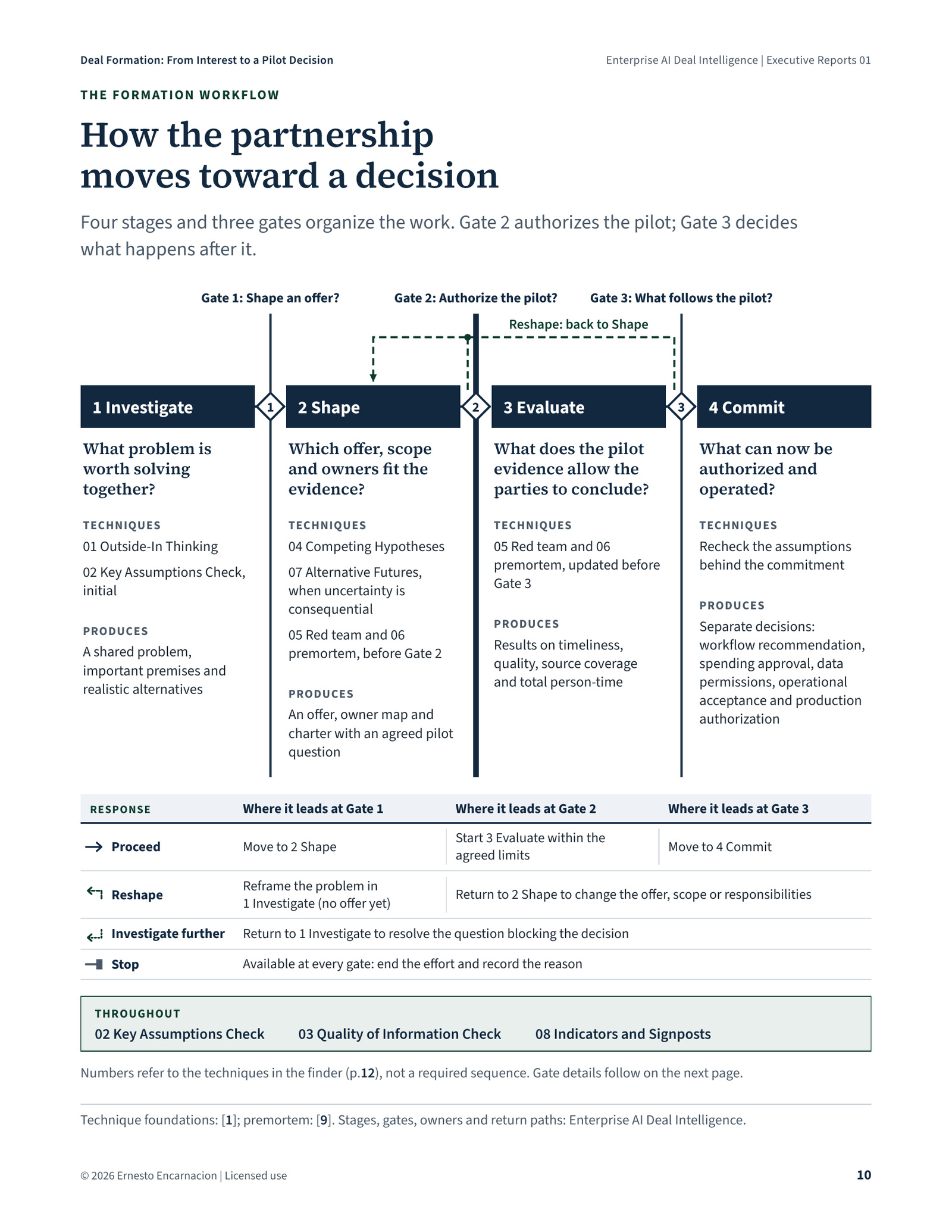
Agree in advance what result would justify proceeding, reshaping the offer, investigating further or stopping. A technical pass alone authorizes nothing.
Governance is not a final step
Checking assumptions, weighing evidence and recording who owns each decision continue from the first conversation to continued use. That is how governance keeps pace as the enterprise learns.
89%
60% and 59%
These surveys describe what leaders report. They do not measure why any particular partnership succeeds or fails, which is why the questions above matter for each opportunity.
The decision map
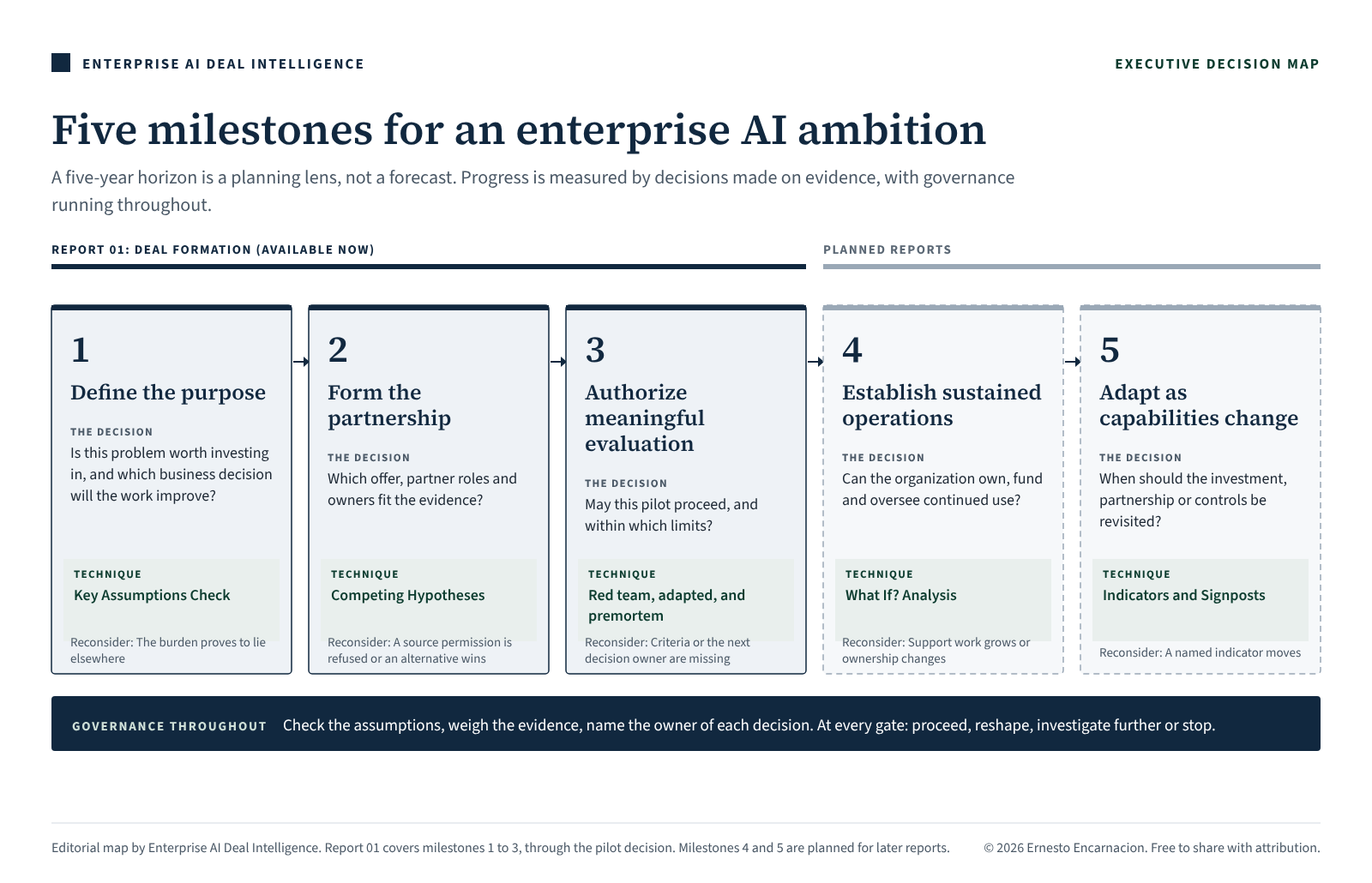
A five-year horizon is a planning lens, not a forecast. Progress is measured by decisions made on evidence. Select a milestone to see the decision, the assumption to test, the evidence that matters, who decides and the technique that helps.
Identify the business problem and whom resolving it serves.
Identify the capabilities, owners and responsibilities required across organizations.
Define the decision the pilot should inform, the permitted inputs and the agreed criteria.
Examine workflow ownership, integration, operating acceptance, funding and oversight for continued use.
Planned for later reports. Report 01 ends at the pilot decision.
Identify indicators that should trigger reconsideration of the investment, partnership, controls or operating approach.
Planned for later reports. Report 01 ends at the pilot decision.
These five milestones are an editorial map for the wider library. Report 01 covers the first three, through the pilot decision, using its own four-stage, three-gate workflow. Milestones 4 and 5 are planned for later reports.
Download the map (PNG) Free to share. No sign-up.
Audience perspectives
Everyone receives the same report. Each view below shows where your responsibilities sit in it.
A promising buyer liked the demonstration. Weeks later, replies have slowed and nobody has authorized anything.
Questions to answer
From the report
Silence can mean shifted priorities, a procurement or security queue, a wait for the incumbent platform or unconfirmed funding authority. Each calls for different evidence and a different response. If nobody has named a spending approver, ask which approvals the next step needs and offer the material those approvers require.
What Report 01 contributes: a way to shape a proposition around the buyer's real problem, test it before pilot authorization and know what evidence the next decision needs.
Several providers propose AI pilots. Each sounds useful, and each would draw on the same people, data and budget.
Questions to answer
From the report
If licensed sales data cannot enter the pilot in time, first confirm whether internal and permitted public sources can still answer the pilot question. If they can, test on them and make the licensed-data phase a separate decision.
What Report 01 contributes: a decision-owner map for both sides, the questions to ask before committing resources and an eleven-element pilot charter that separates technical findings from authorization.
The strategy is agreed in principle. The engagement scope, partner roles and operating responsibilities are not.
Questions to answer
From the report
Reviewers challenge who will keep the permitted source collection current. Nobody has been assigned. The parties name the content owner as source-update owner and record it in the pilot charter, because the pilot's measure depends on current sources.
What Report 01 contributes: a workflow that connects strategic intent to engagement scope, partner responsibilities and a pilot charter that names who owns each part of delivery.
Available now
Where to use structured analytic techniques, and why, when forming enterprise AI partnerships in pharmaceutical commercial operations.
Report 01 is the practical starting point: problem definition and partnership formation, through to the decision on a pilot. It follows one running example from first request to pilot charter.
Payhip handles checkout and delivers the PDF by download link. The preview downloads directly; no sign-up needed.

About the author
Life Sciences Commercial Strategy and Operations
Ernesto brings more than 20 years of experience in commercial operations within the life sciences industry. He graduated with honors from the University of Pennsylvania, where he studied Organizational Studies, and from Georgetown University's master's program in Applied Intelligence.
His reports bring intelligence-analysis methods to enterprise AI partnership decisions: defining the problem, testing the reasoning and preparing a decision both sides can own.
A 48-page PDF (US Letter, 3.4 MB): Report 01, Deal Formation: From Interest to a Pilot Decision, October 2026 edition, revised 27 October 2026.
The license covers the named reader(s) on the purchase record. Internal reading, printing and application are permitted within that user limit. No redistribution, public posting, resale or republication.
Team licenses are not yet available for direct purchase. For more than one reader, email Your_PDF_Lab@proton.me.
A five-reader license is available for : buy the five-reader license. For other team sizes, email Your_PDF_Lab@proton.me.
Payhip handles checkout and delivers the PDF by download link after purchase.
The milestones, worked example, audience views and applications are the author's. They are not findings of these sources.